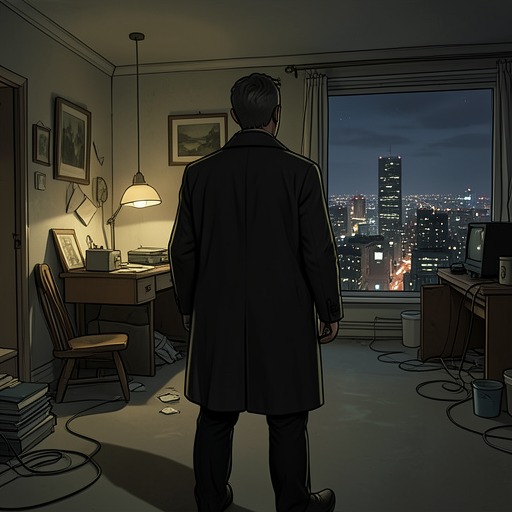
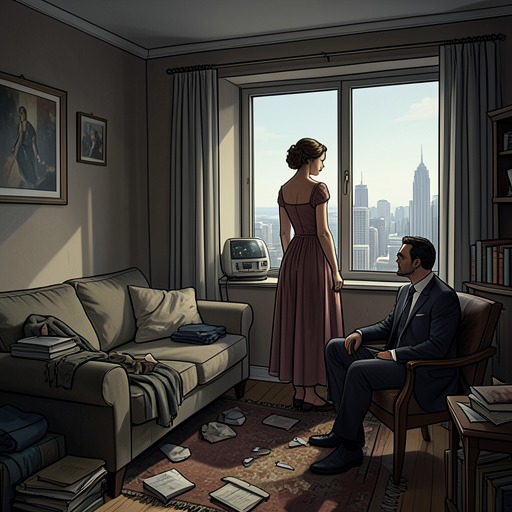
Tom Wingfield’s entrapment and urge to escape
The Glass MenagerieTom Wingfield’s entrapment and urge to escape drive him between the warehouse that consumes his days, the family obligations that make leaving consequential, and the imagined freedom of travel. His escape is not a clean break: years after leaving St. Louis, he describes himself as pursued by memories of Laura, so that movement becomes both an attempt to get away and a reminder of what cannot be left behind.
Identity and Background
Tom’s confinement has a material shape. He works at Continental Shoemakers in a windowless-seeming interior of celotex and fluorescent tubes, and earns sixty-five dollars a month. The work is not merely dull to him: he imagines spending fifty-five years there and says he would rather have his brains battered out than return in the morning. His extreme language gives the routine its force, presenting employment as the surrender of the life he dreams of having and becoming.
That job also supports a household whose security Amanda fears losing. When she challenges Tom for jeopardizing his employment, he answers that he has been giving up his ambitions for the family, not thinking only of himself. He points to his father’s photograph as the image of the person who has already gone, and invokes the reach of transportation as the distance he might travel. The photograph makes escape at once a possibility and a family precedent: Tom’s imagined departure follows the example that left his mother and sister behind.
Work, Family, and the Everyday Escape
The movies offer Tom adventure in a life that provides little of it. He explains that he goes because he likes adventure and finds little at work; Amanda counters that he goes too much. Their disagreement gives his repeated outings two meanings: they are a real habit of escape from the warehouse, but they cannot yet change his circumstances. The cinema supplies an imagined elsewhere while he continues to return to the same job and household.
The question of Laura’s future sharpens the family pressure around his own. Amanda says Laura is two years older than Tom, that nothing has happened for her, and that she frightens her mother by drifting along doing nothing. She insists that the family must make plans and provisions, imagining a home of Laura’s own with a husband. Tom’s possible departure is therefore entangled with an unresolved responsibility: Amanda sees him as part of the household’s practical security, while her concern for Laura makes clear how little settled provision either sibling has.
Tom’s anger breaks through when Amanda grabs his arm as he tries to go. He tells her not to grab at him, then says he is going to the movies. The physical gesture makes the conflict over freedom immediate: his departure from the room is resisted by the person who depends on his staying, and the movie outing is a smaller, temporary answer to a larger wish to leave.
From Movies to a Future Beyond the Warehouse
On the fire escape, Tom’s language changes from complaint to decision. With movie-house marquees lighting his face and an image of a sailing vessel bearing a Jolly Roger on the screen, he says he is planning to change. He describes himself as close to committing to a future that excludes the warehouse, Mr. Mendoza, and even a night-school public-speaking course. The image of the voyager gives visual form to the change he claims to be approaching, while his quiet exhilaration contrasts with the confinement he has just described.
When Jim asks what he is talking about, Tom says he is tired of the movies. The declaration marks a limit in his former refuge: watching adventure is no longer enough, and the change he anticipates must be enacted rather than borrowed from the screen. He reveals that he has joined the Union of Merchant Seamen. Jim identifies the organization as Tom reads its name, and Tom explains the immediate cost of his choice: he paid his dues that month instead of the light bill. Jim predicts that he will regret it when the lights are turned off. The union membership is thus both a concrete step toward departure and a choice that makes the household’s insecurity sharper, setting his personal bid for motion against the family’s need for light and money.
Departure and Its Cost
In his closing account, Tom says that he did not go to the moon but went much farther, and that time is the longest distance between two places. Not long after leaving St. Louis, he was fired for writing a poem on a shoebox lid. He descended the fire escape for the last time and followed his father’s footsteps, traveling widely in an effort to find through motion what had been lost in space. The sequence makes his departure real, but it does not present travel as a solution: the route begins with a job lost over a poem and continues as an unsettled search.
Tom pictures cities sweeping around him like brightly colored leaves torn from their branches. He says he would have stopped, but something kept pursuing him, arriving by surprise. The pursuit may take the form of a familiar piece of music, a fragment of transparent glass, or the sight of a shop window filled with delicate colored bottles like pieces of a shattered rainbow. These possible triggers connect his wandering to the play’s recurrent music and glass imagery without reducing his guilt to a single remembered scene. Even far from home, an incidental sight or sound can reopen what departure was meant to put at a distance.
The pursuit finally takes Laura’s form: she touches his shoulder, and he turns to look into her eyes. Tom admits that he tried to leave her behind but proved more faithful than he intended. He responds by crossing the street, going into a movie theater or bar, buying a drink, or speaking to a stranger—any action that might blow out her candles. His efforts to escape thus persist, but they are framed as evasions of memory rather than a release from it. At the play’s close, Laura bends over the candles and blows them out, completing the image that Tom has made of his continuing, unsuccessful flight from her.
Narrative Significance
Tom’s trajectory turns escape into a double movement. The warehouse, low pay, and family obligations explain why he wants to go; the union dues and eventual departure show that the wish becomes action, with immediate consequences for the household. Yet his later account refuses the simple promise that leaving will restore what was lost. Travel carries him onward, while music, transparent glass, and the image of Laura keep returning him to the family he left.
The fire escape embodies the threshold between staying and going: Tom leans over its rail while announcing a future beyond the warehouse, then descends it for the last time when he leaves St. Louis. The play’s final candles complete the motif from the other side of that separation. His movement can take him from place to place, but it cannot undo his attachment to Laura; the distance that grows between them becomes the medium through which his memory continues to reach him.